.jpg)
How RAG Transforms Your AI into an Expert on Your Business
How RAG transforms your AI into an expert on your business. Discover how RAG technology enables AI to access your internal documents and answer your questions accurately.
Introduction
You're using a consumer AI (ChatGPT, Mistral Le Chat, Gemini, etc.) and you're amazed by its capabilities? There's good reason to be.
But have you tried asking it questions about your company's latest financial report or an internal procedure? As soon as the sources aren't public, it's powerless.
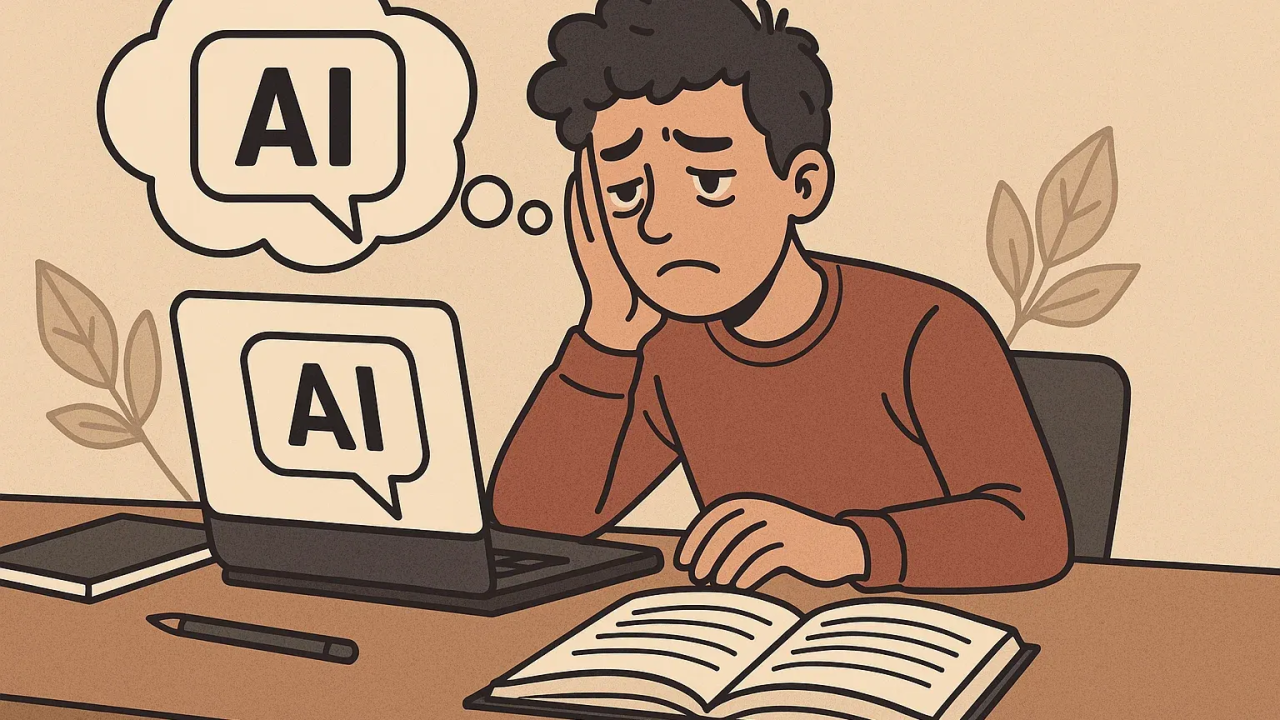
The Problem: An AI That Knows Everything... Except You
AIs like ChatGPT are trained on astronomical amounts of public data. They're experts on the world, but not on your world.
For an AI to be truly useful internally, it needs access to:
- your internal documents
- your HR policies
- your business processes
- your tools (CRM, ERP, drive)
- your databases
In short: everything that makes up your company's DNA.
The Limits of the "Copy-Paste" Approach
Manually adding documents to ChatGPT might seem like a quick and pragmatic solution (if we set aside confidentiality issues).
But in practice:
- it's time-consuming
- you don't always know which files are actually relevant
- you send too many documents or files that are too large, making the AI less effective
- you forget documents or don't use the right versions
- it doesn't integrate information from a CRM or drive
Result: internal knowledge is never complete or structured.
The Context Window: The Achilles' Heel of Our Favorite AIs
AI has a very powerful working memory... but limited. This is its context window: it can only process a certain amount of information at once.
Concrete, Quantified Limits
Today, depending on the models, this window generally ranges between 400,000 and 1 million tokens. At best, 1,500 pages.
That seems like a lot. But if you send 10 documents of 300 pages, you've already far exceeded this context.
➡️ Well beyond what an AI can digest at once.
And the more you send it, the less precise it becomes. It forgets passages or gets the context wrong. It's better to "pre-sort" what you send so that only relevant information reaches it.
This is Where RAG Comes In: The Solution for an "Intelligently Informed" AI
RAG (Retrieval Augmented Generation) is an approach where:
- The tool connects to your sources and pre-processes documents for future searches
- For each query, it searches for relevant "chunks" of documents ("Retrieval")
- It sends the AI the query enriched with these relevant documents ("Augmented")
- The AI then generates an accurate response based on these elements ("Generation")
It's like adding an ultra-fast and ultra-precise librarian assistant to your AI.
 A fast and precise library
Diving into the RAG Engine: How Does It Really Work?
To go further, check out our detailed article on RAG.
Step 1: Intelligent Chunking
First, your documents must be converted into usable text:
- extraction of paragraphs
- retrieval of text from tables
- interpretation of diagrams, charts, etc. (this part is important, as they often contain useful and exploitable information)
Then comes chunking. A good chunk must be:
- short → to fit in the context window
- coherent → one clear idea per block
- isolated → no mixing of concepts
You don't give the entire document to the AI. You give it the paragraph that exactly answers the question.
Step 2: The Search Mechanism (The Magic of Embeddings)
To compare texts, RAG transforms:
- your question
- your chunks
...into numerical vectors: these are embeddings. Two chunks close in meaning → their vectors are close.
Two Essential Types of Search
- Semantic Search (by meaning)
Ideal for conceptual questions: "How do I request time off?"
- Keyword Search (by precision)
Essential for specific terms without universal meaning:
- "Product reference XYZ-123"
- "Procedure PNC-V4"
- "Jean-Pierre Dubreuil"
Because an AI doesn't know Jean-Pierre Dubreuil from the accounting department...
➡️ The two mechanisms are complementary. A purely "semantic" RAG (which is nevertheless common) will fail on this type of search.
Simplified RAG Workflow
 Simplified RAG workflow
Not All RAGs Are Created Equal: The Art of Choosing the Right Solution
The market is full of RAGs that are "quick to integrate," but... there are good ones and bad ones.
What makes the difference:
- Quality of conversion → not knowing how to extract data from a chart = losing important information
- Quality of chunking → chunks too large or incoherent = confused AI
- Choice of embedding models → they don't all excel in the same domains
- Hybrid search → semantic alone = errors on proper nouns
A bad RAG can make the AI vague, approximate, unable to find information that's actually present.
Another crucial point is the integration of complementary tools. If your need is only internal search, a RAG is enough. But generally, you'll also want to search the Web, query database data, trigger actions, etc. Integrating these tools multiplies the power of your AI.
RAG is Engineering
There are clearly best practices and "generic" choices that work quite well. But there's no magic recipe.
Each company has specific formats and data that require particular treatments to achieve good performance.
The Ask This Guy (ATG) Approach: The Best of RAG, Without the Hassle
At Ask This Guy, we've spent hundreds of hours benchmarking, testing, breaking, and then improving RAG pipelines.
We Offer:
- Optimized Conversion and Chunking
Numerous connectors, management of complex documents, tables, slides, images, etc.
- Intelligent Hybrid Search
Semantic + keywords for maximum precision.
- Advanced Personalization
We adapt conversions to your documents and can develop specific algorithms. We can use an embedding model adapted to your business.
- Total Flexibility
You keep control of your data. And if you want to internalize the solution one day, you get back your specific developments.
- One RAG for All Your Use Cases
Deploy the same intelligence across multiple interfaces: admin console, chatbots on your website, widget integrated into your SaaS product, API for your internal tools, etc.
- Software that combines multiple tools, not just RAG
- search in your drives
- web search
- integration with your internal tools
- advanced document processing
The Goal: an AI that knows your company as well as an experienced employee.
Conclusion: Give Voice to Your Enterprise Data with RAG
RAG isn't just a technology: it's a document intelligence strategy.
It transforms a generic AI into a true internal expert, capable of:
- answering questions precisely
- synthesizing complex documents
- streamlining processes
- aiding decision-making
If you want an AI that truly understands your company...
➡️ RAG is essential.
➡️ And we can help you implement it.
Ready to transform how your company uses its data?